Bokashi vs Wormery vs Compost Tumbler: Which Is Best?
As an Amazon Associate I earn from qualifying purchases. This page contains affiliate links — if you buy through them, I earn a small commission at no extra cost to you.
You’ve got three options for kitchen waste: a sealed bucket that ferments everything, a box of worms that turns scraps into soil, or a barrel you spin in the garden. Only one of them works if you live in a flat with no outdoor space.
The Flat-Dweller’s Filter: One Question Eliminates Two Options
The best composting system depends entirely on your available space and what you actually throw away. Bokashi is best for flats because it handles meat and dairy indoors, wormeries are perfect for balconies to process vegetable scraps into rich compost, and tumblers are only suitable if you have at least a metre of outdoor ground space.
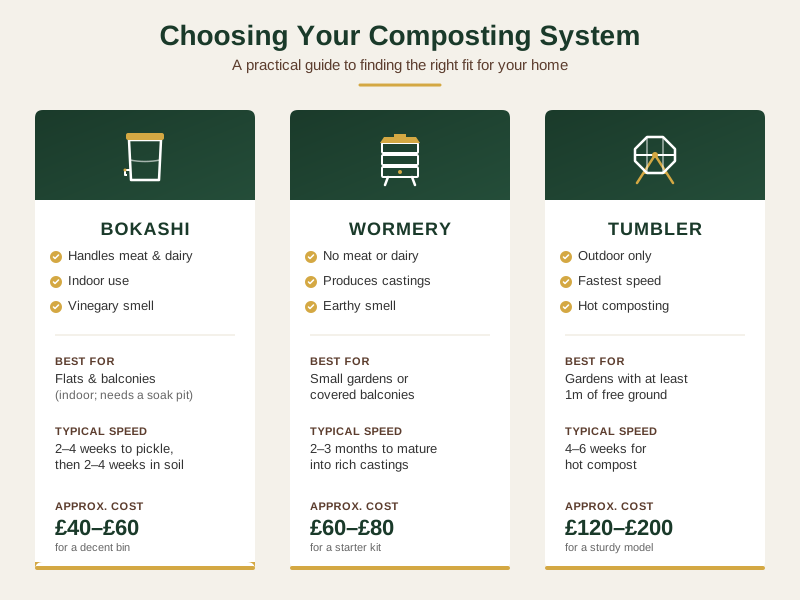
Here is how the three main options stack up at a glance:
| System | Best For | Smell Level | Indoor / Outdoor | Typical Speed* | Approx. Cost (up-front) |
|---|---|---|---|---|---|
| Bokashi | Flats & balconies (handles meat & dairy) | Very low (vinegary) | Indoor (needs a second bin or soak pit) | 2–4 weeks to “pickled” waste, then another 2–4 weeks to finish in soil | £40–£60 for a decent bin |
| Wormery | Small gardens or balcony with a roof over it (no meat) | Low (earthy) | Indoor or covered outdoor | 2–3 months to mature castings | £60–£80 for a starter kit |
| Compost Tumbler | Gardens with at least a metre of free ground | Low to moderate (if kept moist) | Outdoor only | 4–6 weeks for hot compost | £120–£200 for a sturdy model |
*Speed varies with temperature and feedstock.
Key takeaway: Bokashi is the only system that can swallow meat and dairy inside, but it isn’t a “set-and-forget” finish-line.
Option 1: Bokashi — The Fermenter
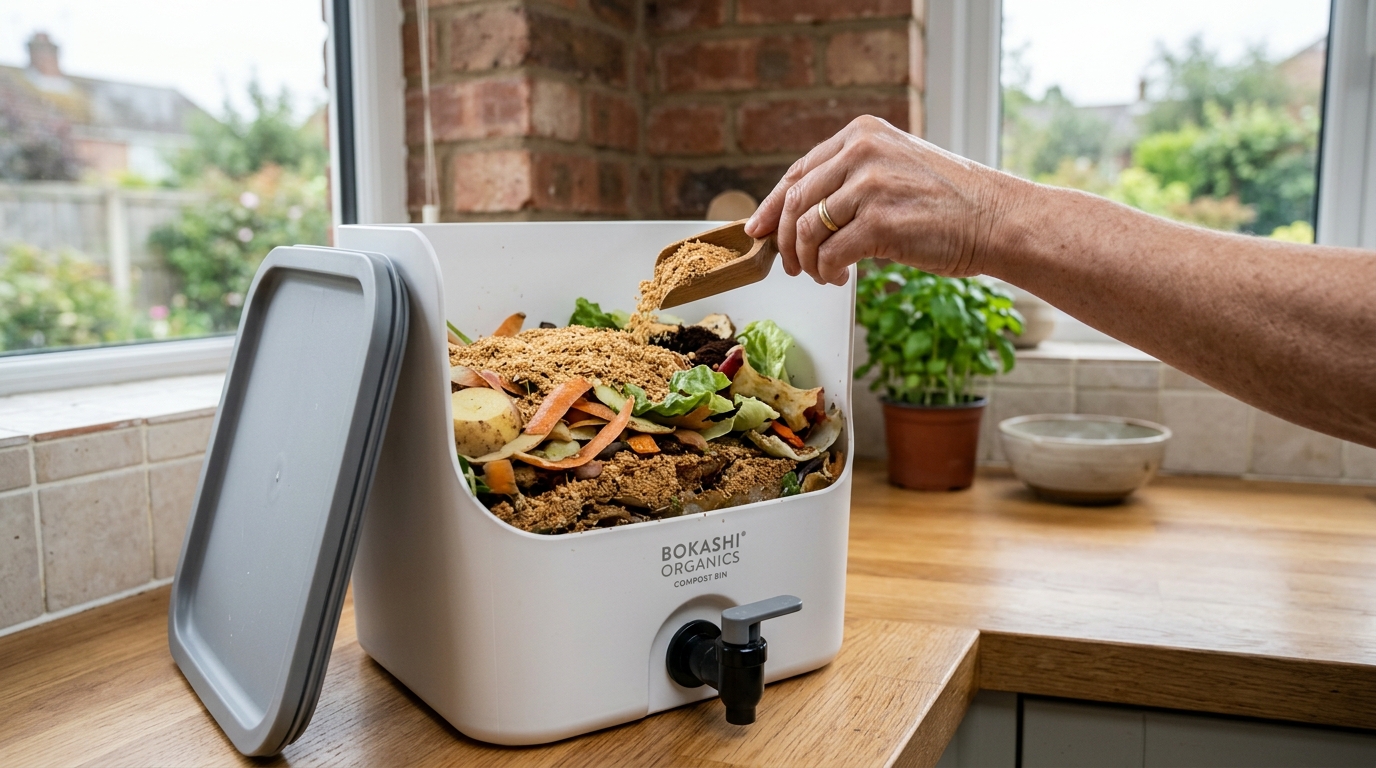
Bokashi works on anaerobic fermentation. As outlined by Garden Organic, it essentially pickles your food scraps using a handful of effective microorganisms (EM) and a sprinkle of bokashi bran. The waste turns into a sour, vinegar-like liquid (the infamous “tea” that needs draining) and a semi-solid mass that looks a bit like soggy, pickled food.
The “Second Step” Reality
The trick most beginners miss is that the output isn’t ready-to-use soil. After the bin is full (usually every two to four weeks), you must do one of two things:
- Bury it in a garden bed or balcony planter, or
- Transfer it to a wormery for a final vermicomposting stage.
Only then does it break down into the dark, crumbly “buried treasure” you can spread on potted plants. Skipping this step leaves you with a pile of sour, semi-decomposed waste that never becomes fertile.
Why It Works for Flats
- Meat & dairy friendly – a huge win for flat-dwellers who cook a lot of roasts or cheese.
- Odour control – the fermentation smell is more like pickled cabbage than rotting meat.
- Compact – a typical 10-litre bucket fits neatly under a kitchen sink or on a balcony shelf.
The Hassle Nobody Mentions
- Ongoing bran cost – a 1 kg bag of bokashi bran runs about £8–£12 and needs topping up every few weeks.
- Second-step hassle – you need a small pit or a worm bin to finish the job.
- Liquid “tea” management – if you let it sit, it can become quite acidic and smell sharp.
I learned the hard way that the “second step” isn’t optional. My first bokashi batch sat in the kitchen for a month, the liquid leaked onto the floor, and I ended up with a sour smell that made the cat bolt. Once I started a simple “soak pit” in a spare balcony flower box, the process was sorted.
Budget pick: The Garland Bokashi Bin (paid link) (around £45) is the best value choice – it does the job but the lid can be a bit of a faff, so give yourself a minute to get the seal right.
Option 2: Wormery — The Soil Factory
A wormery is a sealed box where red wigglers munch organic matter and excrete nutrient-rich castings. The system is essentially a tiny, self-contained ecosystem, and the Royal Horticultural Society rightly champions them as brilliant space-savers for urban gardeners.
Smell Reality
If you keep the bedding moist but not soggy, the bin smells like a fresh woodland floor – nothing more. Over-watering is the main cause of any foul odour, and that’s a mistake I made early on when I thought “more water equals happier worms”. A soggy bin quickly turned into a stinky mess and attracted a cloud of fruit flies.
Pest Myth Debunked
Rats and mice love open rubbish, not a properly sealed wormery. The lid should sit snugly, and a small tray at the bottom catches any drips. In my flat, I once left the lid ajar for a weekend while on holiday; the next morning I found a single mouse nibbling on the bedding. A quick clean and a tighter seal later, and the problem vanished entirely.
What You Gain
- High-quality soil – the castings are a firm favourite among vegetable growers.
- Low ongoing cost – you buy the worms once (roughly £15 for a starter pack) and they multiply.
- Odour-free – completely neutral when managed correctly.
What You Give Up
- No meat, dairy or citrus – these will either kill the worms or create nasty smells.
- Moisture management – you need to check the wetness level weekly.
- Space requirement – a 30-litre unit needs a spot out of the way, such as under a bench or on a balcony with a roof to protect it from heavy British rain.
Budget pick: The Junior Wormery (paid link) (roughly £60) is a solid starter for flats with a covered balcony. It’s lightweight and easy to move, though you’ll need to be diligent about not over-feeding.
Option 3: Compost Tumbler — The Garden Powerhouse
A compost tumbler is a rotating drum that aerates organic matter, keeping the pile hot enough (typically 50-65°C) to break down material quickly and kill weed seeds.
Best For
Only a garden with at least a metre of free ground can accommodate a tumbler. Balconies with railings simply won’t give the drum the clearance it needs to turn safely.
Why Gardeners Love It
- Speed – you can harvest usable compost in four to six weeks, far quicker than a wormery.
- Hot composting – kills most seeds and pathogens, giving you “clean” soil.
- Low labour – just give it a spin every few days.
Why Flats Can’t Use It
- Weight & bulk – even the smallest models weigh 30 kg when empty; moving them is a right faff.
- Cost – a decent tumbler starts around £120 and can climb past £200 for a robust steel version.
- Manual effort – unless you buy a motorised model (an extra £50-£80), you’ll need to turn it yourself.
I once tried to squeeze a 120-litre tumbler onto a balcony rail; the whole thing tipped over and landed on a neighbour’s potted rosemary. Not worth the drama.
UK Winter Performance Comparison by Month
| Month | Bokashi (Indoor) | Wormery (Balcony/Shed) | Compost Tumbler (Garden) |
|---|---|---|---|
| November | Normal operation | Slight slowdown, keep feeding | Last turning before dormancy |
| December | Normal operation | Reduce feeding by half | Frozen, no activity |
| January | Normal operation | Minimal feeding, check insulation | Frozen, no activity |
| February | Normal operation | Dormant, check moisture | Thawing, still inactive |
| March | Normal operation | Resume normal feeding as temps rise | First turn of the season |
Key insight: Bokashi is the only system that performs identically year-round because it lives indoors. Wormeries and tumblers both slow or stop between December and February. If you want continuous winter processing in a flat, bokashi is the only practical choice.
Do You Already Have a Council Food Waste Bin?
Before buying anything, check your council’s waste collection. Most UK local authorities now provide a free food waste caddy. Here’s how that changes your decision:
| Your Council Provides… | Implication |
|---|---|
| Weekly food waste collection | A bokashi or wormery becomes optional — you already have a zero-landfill route. Many people still choose bokashi for the tea and reduced caddy smell. |
| Fortnightly food waste collection | Bokashi reduces caddy odours between collections and gives you plant feed. A wormery gives you castings but requires more attention. |
| No food waste collection | Bokashi or wormery is essential if you want to avoid landfill. Bokashi handles more waste types; wormery gives better finished compost. |
| Garden waste bin only | Bokashi pre-compost can go in the garden bin. Wormery castings go straight onto plants. |
My take: Even with a council caddy, a small bokashi bin under the sink makes kitchen life more pleasant. The caddy doesn’t smell of vinegar — the bokashi does, but that smell stays sealed in the bucket.
The Real Costs: First Year vs. Fifth Year
When you look beyond the sticker price, the ongoing expenses start to matter.
- Bokashi – Up-front: £40–£60 for the bin. Recurring: roughly £10 per month for bran if you compost for a family of four.
- Wormery – Up-front: £60–£80 for a starter kit. Recurring: virtually nil – the worms multiply and you only need occasional bedding (shredded newspaper or cardboard, which is free).
- Tumbler – Up-front: £120–£200. Recurring: minimal – you may need a bit of extra water in dry summers, but no consumables.
If you are trying to decide which system will cost you the least over a year, the numbers are fairly clear. A bokashi setup typically costs around £150 to £180 in the first twelve months once you factor in the regular purchase of bran. A wormery, after the initial £60 to £80 outlay for the bin and starter worms, will likely sit under £30 for the whole year, mainly for occasional bedding like shredded cardboard. A compost tumbler, while expensive to buy, has almost no running costs, so after the initial £120 to £200 investment you are looking at practically nothing a year to run it. If you are on a tight budget, a wormery is the cheapest to run long-term. Bokashi is the most expensive because of the bran you keep buying, while a tumbler is a hefty upfront investment that pays for itself if you have the garden space.
Realistic Space Requirements for UK Homes
| Property Type | Bokashi | Wormery | Compost Tumbler |
|---|---|---|---|
| Studio flat (no balcony) | Fits under sink (30×30cm) | Possible on kitchen counter (40×40cm) | Not suitable |
| 1-bed flat with small balcony | Fits under sink | Fits on balcony (needs weather cover) | Not suitable |
| 2-bed terrace with yard | Under sink or utility room | Yard corner or shed | Possible if 1m² free ground |
| 3-bed semi with garden | Under sink or garage | Shed or garden corner | Ideal — full sun spot, 1.5m² |
| Allotment | Not practical at scale | Possible for kitchen scraps | Best option for bulk processing |
The terrace reality: A typical UK terrace house has a yard of 10–15m². A compost tumbler needs roughly 1m² of clear ground plus turning clearance, which is realistic if you don’t also store bikes, bins, and a washing line there. Most terrace owners choose a wormery or bokashi because they need less than 0.5m².
Common Questions
Can I put meat in a wormery?
No, you cannot put meat, dairy, or citrus in a wormery. Worms simply cannot digest these dense proteins and fats, and adding them will either kill your worms or create a nasty smell that attracts flies. If you need to compost meat, a bokashi bin is the way to go.
Do Bokashi bins smell?
No, a healthy bokashi bin does not smell like rotting food. During fermentation, the bin gives off a mild, pickled-cabbage or yeasty scent. The smell only becomes an issue if it goes anaerobic and you let the fermented waste sit too long before moving it to the second step.
How often do I have to empty a Bokashi bin?
You typically need to empty a bokashi bin every two to four weeks, depending on how many people are feeding it. Emptying it sooner just means you’ll have more frequent “second steps”, which is perfectly fine.
What to Do Now
You’ve seen how each system lines up against space, smell tolerance and budget. The key is to match the method to your living situation rather than chasing a “best overall” label. If you’ve decided that bokashi’s meat-friendly fermentation fits your flat, or that a wormery’s black gold is perfect for your balcony, the next step is simply to plan the setup.
Head over to the blog to grab the Free Composting Starter Checklist and map out the exact steps for your chosen system. And if you want a laugh at how I mucked up my first few tries, read my full story on the about page.
There is no one-size-fits-all — pick the system that matches your space and your waste, and the worms (or microbes) will take care of the rest. If you get stuck, you can always reach out via the contact page.
Related Guides
For a complete overview, see our Bokashi vs Wormery: Which Is Right for Your Flat?.
Where I Learned This
- Garden Organic - Expert advice on bokashi composting
- Royal Horticultural Society - Guide to worm composting
- WRAP (Waste and Resources Action Programme) - Food waste reduction guidance
- Soil Association
As an Amazon Associate I earn from qualifying purchases. The products linked above are ones I would use or recommend in my own garden setups.
Note: The information provided above is for general guidance only. Always verify specific details with a qualified professional or official source before making significant purchases or changes to your waste management system.